Good Morning and happy Friday! This week is a classic collection of recent headlines and what they really boil down to. Which drinks could actually improve your health? Which drinks might be hiding major allergens? We talk about that and some really exciting sustainability innovations this week.
Let’s dive in!
Drinking Wine Might Actually Be Good For You?
The Ever Changing Health Info About Your Choice of Poison
So we know that alcohol is bad for you, but because we are always trying to find a silver lining science has graced us with one. In a recent study not only were amounts of alcohol consumption compared but so were the kinds of alcohol. The three main categories were wine, beer (and cider), and spirits. The main take-away was still that drinking increased risk of death by any cause, risk of cancer, and risk of cardiovascular disease. The more interesting news to come out of the study was that it actually saw some health benefits to those who drank wine occasionally. “Looking at deaths from cardiovascular disease in particular, researchers found that moderate wine drinkers had a 21% lower risk of dying from cardiovascular disease compared with never or occasional drinkers. By contrast, even low intake of spirits, beer or cider was associated with a 9% higher risk of dying from cardiovascular disease compared with drinking never or occasionally.”
There have been studies in the past that suggested that the antioxidants in red wine had health benefits but there are so many other factors that researchers were able to connect with this seemingly anomalous finding. Researchers did their best to adjust for socioeconomic factors, family health history, etc. and in doing so were able to track the other associated habits that might correlate wine drinking with increased cardiovascular health. Wine was more often drank alongside meals. These meals were also often considered more healthy and balanced and consumed by individuals whose habits were generally healthier overall. Beer, cider, and spirits were often consumed outside of meals or alongside meals that were considered less healthy overall.
At the end of the day the headlines are more clickbait than breaking news. If you consume in moderation and lead a healthy life chances are your overall health will reflect that. Some people will continue to defy the data and eat poorly and drink heavily and live to 100. It is always nice to have a study to fall back on if you need an excuse to pour yourself a glass of wine after a long day though.
Celebrity Gin Facing Waves Of Challenges
Margot Robbie’s Gin Is Off To a Rocky Start
There’s another celebrity spirit making headlines: Papa Salt. The brand was founded by Margot Robbie and four of her friends and was designed with botanicals that reflect the Australian coast. None of this seems particularly newsworthy of course, but it’s the choice of botanicals that is causing a stir in the spirits and allergen communities. Some of the botanicals included are oyster shells, roasted wattleseed, and pink peppercorns.
Headlines claim that bars and restaurants are refusing to serve Robbie’s gin because of the concern of allergens. These articles also claim that complaints have been brought to the brand directly in this respect. Papa Salt, in response to allegations made in The Guardian, denies the claim that any bars have refused to stock the product because of it.
The spirits industry is in a strange limbo state when it comes to allergens. Spirits are not required by law to list ingredients but they are required to list known allergens. We know now that the distillation process removes allergenic proteins from the final product. This is why most whiskeys can still be labeled as gluten free. Some gins, including Bombay Sapphire use nuts in their botanicals. It is believed that none of the nut proteins that trigger the allergic reaction survive the distillation process but many brands still urge caution because they can’t be absolutely certain that 100% of the allergens were eliminated. In the UK there are exemptions for certain allergens because they have been proved to not survive the distillation process. These include cereals, whey, and nuts.
Papa Salt does label their product with the appropriate allergen warning. “The brand has also commissioned ‘extensive’ allergen testing through Agrifood Technology, an independent Australian laboratory, which found no detectable risk from allergens. The spokesperson added: “Out of an abundance of caution, the brand declared molluscs an allergen on the bottle.””
The allergen community, including The Natasha Allergy Research Foundation, urges extreme caution noting that for those with life-threatening allergies there is no true way to trust a product that includes known allergens at any stage of production.
Leading The Whiskey World Into Sustainability
New Distillation Methods Show Promise
Suntory Whiskey is blazing a new trail in distillation. Hydrogen has long been eyed as an alternative fuel source by environmentalists because of its ‘cleaner’ burn. When hydrogen is burned the off-product produced is water as opposed to carbon dioxide which is produced by the burning of fossil fuels. This means that products made using hydrogen instead of other fuel sources have a theoretically much smaller carbon footprint. I say theoretically because the way that the hydrogen is sourced has everything to do with how environmentally friendly it really is.
Suntory, in partnership with Supercritical, has been working on what it has dubbed The WhiskHy Project in order to reduce emissions from distillation. The project uses Supercritical’s electrolyser to collect ‘green’ hydrogen. This hydrogen is then used to distil the whiskey and is credited for radically cutting carbon emissions. The whiskey produced from this run is now aging and will not be available for some time. The project is being seen as a success and shows promise for other applications. “Suntory and Supercritical have committed to working together again, pursuing investigations into the applications of hydrogen in decarbonising the malt distilling process.”
Best Video We Saw This Week
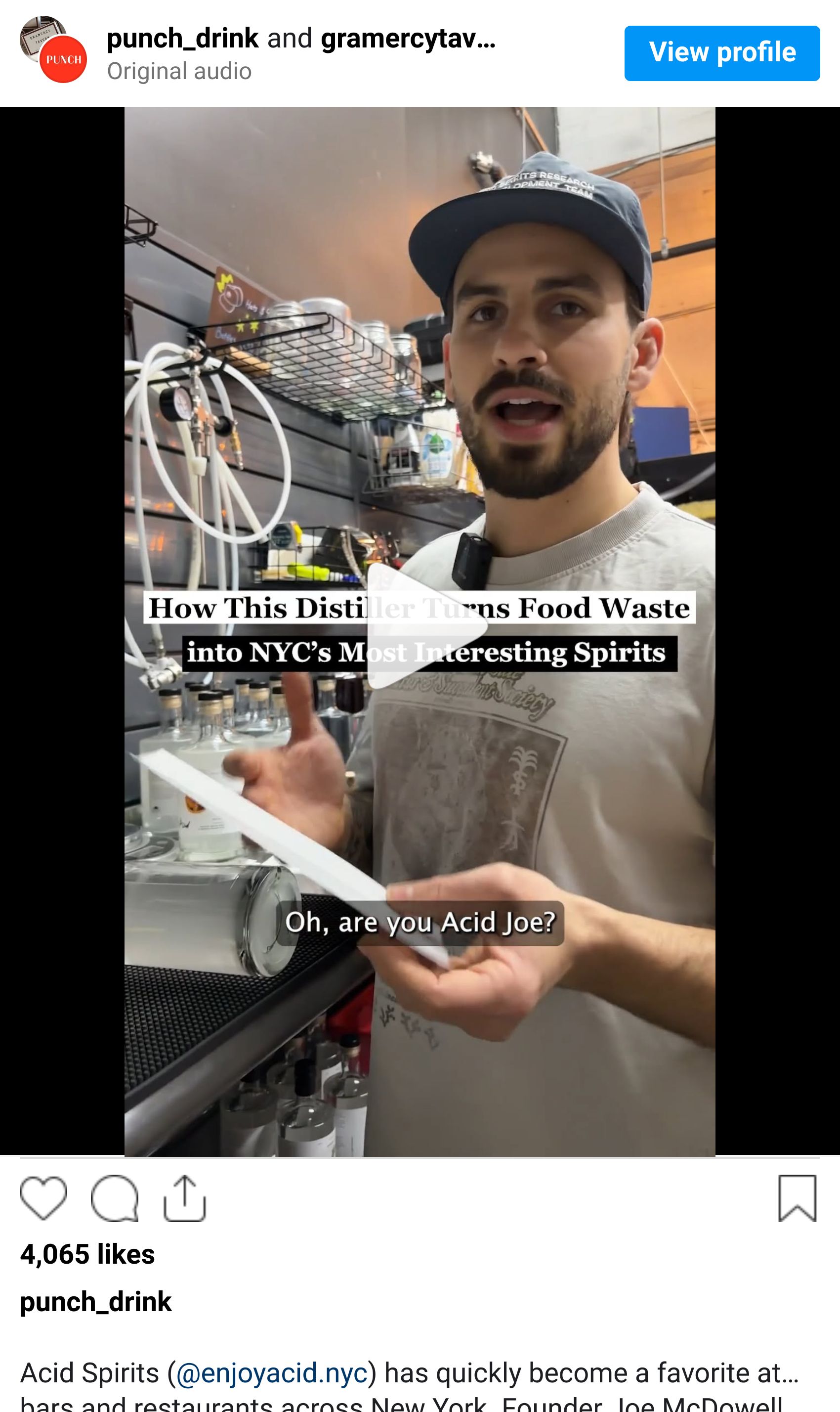
We looooove innovations in sustainability and this has to be one of the coolest ways to do it. This is definitely much more feasible in more urban areas where the access to food refuse is a little higher in volume and a bit more predictable but it is a wonderful idea and could definitely inspire others to make use of scraps and rejects in their own communties.
Quick Hits:
The Uncle Nearest drama continues. Lawsuits on lawsuits on lawsuits.
The queen of rum, Maggie Campbell, talks about how she wants to make the US a rum nation.
